Saturday, October 31, 2009

Local Diet Update - 2009 Halloween Edition

Let's just say this morning's Brazos Valley Farmers' Market gave everyone a scary good time! And it was good to see all those friendly faces as well as lots of new people at the market. Hopefully that means all the advertising we've been doing through the "Friends" group is working.

It really was an absolutely amazing morning! We had tons of vendors dressed for the festivities (more than normal for this time of year, including a meat vendor), a steady stream of customers (with lots of kids for trick-or-treats from vendors), and a wonderfully successful raffle for a special halloween cake donated by Karen Jozwiak which raised money for the Friends of the Brazos Valley Farmers' Market (thanks, Karen!).

Hopefully this will be an event that people talk about for a long time. I know I had a blast and we were all taking about doing it again for Christmas. But instead of just telling you about the morning. Check out these photos...
  • The photo up top is Marjorie Beeler, salsa and veggie vendor
  • Next is Roger and Donna Burton (bread and salsa vendors) dressed as Mr. and Mrs. Dracula
  • And finally, below we have David Elsik (veggie vendor) as a scary garden attaching Richard Shubert (egg and veggie vendor) as a "Chick Magnet" (it's hard to tell from the photo, but he's wearing a huge magnet around his next with little baby chicks attached - definitely the most creative!)
I dressed up as a veggie garden too, clothed in all greens and browns with a special veggie helmet atop my head, designed by friend, artist, and local hospice chaplain Cherry Moore (thanks Cherry!) You can see my veggie helmet in the photo of my farmers' market haul at the bottom of the post - you'll see it behind the container of whole wheat flour. It's a hat of greens with some carrots and radishes mixed in for color. I loved it!

Things were so busy, I didn't get a list compiled of all the day's market offerings but it was an enormous spread of fruits, veggies, breads, canned goods, and sweets. Of course, I did manage to snap a photo of what I can home with, including bought, bartered, and given (that's it there at the very bottom). Let's see, there's 4 bars of soap (I had 5, but I'd already given one as a birthday gift by the time I came home), 2 Halloween cupcakes for Dave, a beautiful spiral of bread, 2 cucumbers, 9 pears, a containers of whole wheat flour, lots of red potatoes, and a bag of green beans.

Between this and all the goodies we still have at home from our garden (sweet potatoes, green peppers, green onions, sage, basil, and green beans), we're going to be eating well again this week.

Hope everyone else out there is having a wonderful Halloween so far. Next is the party here at home. We're expecting guests at our home to enjoy homemade pizza, pumpkin bread, and punch, while we hand out candy to anywhere from 500-700 trick-or-treaters. Time to get busy...

Happy Halloween, everyone and Happy (and mindful) Eating!


Friday, October 30, 2009

Whole Wheat Banana Cookies (vegan)

I have been busy in the kitchen again. Actually, I put in another 20 miles of biking today, so maybe I was just hungry...

Anyway, I had some organic bananas in the cabinet that were WAY too ripe and I couldn't quite decide what to do with them. Then I thought about how totally easy those vegan pumpkin cookies were earlier this week and decided between that recipe and a little creativity, I could make a banana cookie to die for. Let's just say... YUM!

I halved the pumpkin cookie recipe, left out the ginger, substituted 3 overripe bananas for the pumpkin puree, and used my local whole wheat flour instead of white. Here's what the new recipe looked like:
Whole Wheat Banana Cookies (vegan)
  • 1 cup brown sugar
  • 1 teaspoon vanilla
  • 1/2 cup vegetable oil
  • 3 overripe bananas
  • 1 tsp baking soda
  • 1 tsp baking powder
  • 1 tsp cinnamon
  • 2 cups flour
  • 1 cup nuts (optional)
Preheat oven to 350 degrees and line a cookie sheet with parchment paper.

Cream brown sugar, vanilla, oil, and bananas in a mixer. Combine dry ingredients and add slowly to wet ingredients. Blend until smooth.

Drop by teaspoon onto lined cookie sheet and bake for 15 minutes. Allow to cool for a few minutes on the cookie sheet and then move to a rack to cool.

Makes just over 2 dozen cookies.
I have to say, I absolutely LOVE these cookies. They remind me of banana nut muffins. Not only are they delicious, but they're vegan and that whole wheat flour makes me feel healthy. Does that make sense? But don't listen to me. Give 'em a try!

Halloween 2009 - Preparations

It's finally here! My favorite holiday of the year and we have big plans!

First, we'll have a special celebration at our farmers' market tomorrow with a raffle, free treats for kids who come in costume, and booths with wonderful decorations (and with any luck some vendors who dressed for the occasion as well - I'll be sure to get some photos). It's going to be a wonderful morning at the farmers' market, so if you're local, come on out! And be sure to stop by the market info booth. I made pumpkin cookies and pumpkin pie bread to hand out to visiting customers.

Then, we'll celebrate Halloween at our house. We've invited the neighbors to the house for my homemade pizza and more of that pumpkin pie bread. We'll fill our plates, and sit in lawn chairs in the driveway handing out candy to all the little trick-or-treaters (we get anywhere from 500-700 kids per year). Yeah. That's not a type-o. Halloween in our neighborhood is ALWAYS a blast. What are you doing to celebrate?

Thursday, October 29, 2009

Fair and Feminist - SGF on the Radio

Looks like it's going to be another rainy day here in Central Texas. That's ok. I have lots to do inside and with any luck, I'll sneak out between rain bursts for a nice walk. In the meantime, mark your calendars...

Tune into local radio station KEOS 89.1 for Fair and Feminist this Sunday, November 1 when hosts Shelly and Vandy will be interviewing me from 6-7PM on Simple-Green-Frugal, the Brazos Locavores, and the Friends of the Brazos Valley Farmers' Market.

For those of you who aren't local, you can hear the live stream here.

Catch you on the airwaves!

Wednesday, October 28, 2009

Preserving Pumpkin Puree

Uh huh. Say that three times!

I'd been waiting to process those two extra pumpkins from the farmers' market to test my new blender. Yep, that's right. After thinking about it for 2 years, I finally purchased a blender. I'll pause to allow some of my family members to faint and recover...

But seriously. I didn't want to buy one unless I was sure I'd get good use out of it. Well, now that our housemate has been living with us for 2-1/2 months and I've used her blender probably 10 times, I decided that YES, indeed. I would definitely use a blender on a regular basis. She arrived on my doorstep just last night making today her amazing debut!

Just like last week in Lovin' From the Oven, I halved the pumpkins and put them on a cookie sheet to bake in the oven at 350 degrees for about 45 minutes to an hour. After letting them cool, I removed the peel and cut the pulp into pieces to better fit in my awesome new mixer (ain't it pretty?).

Note: When reviews said this blender was loud, they weren't kidding - let me apologize now if I woke up any of our neighbors from an afternoon nap. But it's also supposed to be the best in it's price range and I wanted something simple and heavy duty.

Anyway, simple it was. With only two speeds, the blender managed to puree all that pumpkin into a nice gooey, but delicious pumpkin-y mess. Then, of course thanks to the advice from all you wonderful readers, I placed it in a strainer to drain out any liquid excess before I measure it in 2 cup increments (about 1 can's worth) and freeze it tomorrow.

With any luck, we'll be enjoying lovin' from the oven (aka pumpkin pie) all year round. Now why have I never done this before?

Thanks everyone for helping me out this time through!

Tuesday, October 27, 2009

Campus Sustainability Day 2009

Today, I hosted the Farmers' Market info booth at the Texas A&M University Campus Sustain-ability Day 2009. And was I in good company! Next to me were representatives from Edible Aggieland and the Campus Community Garden. And not far away were the Be Green in Bryan group as well as lots of other familiar faces and groups from around the community.

It started out a bit chilly, but I managed to bike over to the event and enjoy four hours of visiting with students, staff, and faculty about the amazing farmers' market we have right here in the Brazos Valley.

A big THANK YOU to the coordinators of the event and for John Borden (of Edible Aggieland) for keeping us entertained as he posed for photos around the community garden veggie display.

Monday, October 26, 2009

Rainy Day

It's an all day rain-athon here in Central Texas. I love rain! I mean seriously, it makes my garden happy and when my garden is happy, I'm happy. But when it rains ALL DAY like this... well, I get kinda stir crazy. So I've been trying to keep myself busy indoors - cleaning (blah), lifting weights (blah), and baking. Now, THAT's not so bad.

Let's see... I started off making two loaves of pumpkin pie bread for the Halloween get-together we're having at our house next weekend. I popped those in the freeze so they'll keep until the weekend.

Then I whipped up the dough for two loaves of my whole wheat bread. They're on the kitchen counter in a final rise before baking.

And finally, I tried a new recipe, Vegan Pumpkin Cookies, that I'll be handing out at my booth on Saturday at the farmers' market - we're having a special Halloween Celebration with lots of goodies, decorations, and a raffle. As far as the recipe goes, I went ahead and skipped the nuts and the raisins because I don't have them and well, it's pouring and I don't feel taking another shower while walking t0 the store. I'll admit I'm lazy (at least until it stops raining)...

Anyway, with these cookies being egg and dairy free, I was actually able to sample my wares this time and WOW are these little cookies good! They have a cake-like consistency and are just fabulous! You'd never know they were vegan! Not to mention, they should freeze well until I need them next weekend.

So if you're looking for an easy, healthier recipe for a tasty fall cookie, definitely give these a try.

Ok. What's next? Oh, right. I have a Menu for the Future class tomorrow. Better get reading that chapter....

Sunday, October 25, 2009

Local Diet Update - October 25, 2009

Saturday made for the perfect fall day and a wonderful farmers' market. I actually loaded down my bike (including a lawn chair) and peddled down to the market. It was quite a sight with me in a heavy winter coat (it was 48 degrees when I left the house) and my booth supplies bungee corded to the baskets over the back wheel.

The market itself was loaded down with an amazing harvest just waiting for the taking. Check it out... Available at this week's Brazos Valley Farmers' Market were:
Veggies and Fruits: pumpkins, red potatoes, yellow onions, hubbard squash, patty pan squash, eggplant, carrots, cherry tomatoes, sweet potatoes, cucumber, yellow squash, zucchini, green beans, a variety of hot and sweet peppers, okra, spinach, herbs, black eyed peas, peanuts, dried apples, and pears
Baked Goods: yeast breads, herb breads, cheese breads, sweet breads, peanut brittle, cookies, pies, cakes, cheesecake bars, pecan bars, dog treats

Canned Goods: jams, jellies, salsas, pickles, chow-chow, relish, veggies, chutney

Other Foods: cornmeal, grits, wheat flour, eggs, honey, pepper sauce, jalapeno oil, locally-roasted coffee, olive oil

Non-Food Items (hand-crafted): stained glass art, decorative plants, fruit trees, aprons, jewelry, pot holders, stuffed animals, candles, pillows, christmas tree ornaments, purses, wallets, bags, greeting cards, plaques
Because of my splurge at the market last weekend, I really needed to get back on track with my 100 Day Challenge (where I attempting to buy nothing but fruit for myself for the last 100 days of the year - relying on my garden, my pantry, and whatever I could barter for). So, I promised myself I'd stick to my list this week and picked up only what was needed. And I did (though I'll admit it was difficult...) Not everything was bought, some of it was given and others bartered for.

This week, I came home with carrots for Dave, honey, whole wheat flour, eggs, two pumpkins, pears, and a cucumber. The pumpkin will be roasted, pureed, and frozen for pies later in the year, veggies for Dave will be steamed for his dinners, the eggs are for the pumpkin pie bread I'm making for our Halloween party next weekend, the honey and flour is for my whole wheat bread recipe, a staple in our house (and great for bartering since so few people make homemade bread anymore), and the pears and cucumber are just for nibbling.

Aside from the new goodies, I have plenty of all-local foods throughout the kitchen and pantry room - veggie stir fry, spaghetti squash, and a few potatoes still in the fridge; soups, pasta sauce, corn, brown rice, and pecans in the pantry; oogles of sweet potatoes stored in the coat closet; and a bazillion green peppers, some green onions, lettuce, sage, and basil in the backyard just waiting to be picked. Did I mention all of that was local? Sometimes I just LOVE living in Central Texas!

Well, enough for now. Have a great week, everyone. And, as always, Happy (and mindful) eating!

Saturday, October 24, 2009

Brazos Locavores - November Field Trip to the TAMU Pecan Orchard

We have another exciting trip planned for November! The Brazos Locavores will experience a Texas favorite offered right here in the Brazos Valley – the TAMU Pecan Orchard.

The original owners, respectful of the land, wanted to share it with others and preserve the land for generations to come. They first established the orchard in the 40’s, soon after creating a second orchard in the 80’s. In fact, they just completed the final addition in February 2009. Today, the orchard contains more than 20 acres of land, making up the 3 orchards.

The TAMU Pecan Orchard is located 8 miles out side of College Station, Texas off Highway 60. This is a trip that you don’t want to miss! We will be touring the beautiful venue while learning about the various pecan trees, the different types of pecans, as well as on-going experiments taking place at the orchard. Even better, with this being pecan season, we will have the opportunity to purchase bags of pecans harvested on-site.

Here’s the scoop:

What: Brazos Locavores Field Trip to TAMU Pecan Orchard

When: Saturday November 7th (1:00- 4:00)

Where: Brazos Natural Foods (we’ll be meeting in the parking lot at 1:00 and carpooling out to TAMU Pecan Orchard)

Who: Everyone! Don’t forget to bring the kids!

RSVP: to brazoslocavores@gmail.com by Wednesday, November 4th so that we can let the Orchard know and prepare for the number of attendees

See you there!

350.org's International Day of Climate Action

I just got back from our local celebration of 350.org's Inter-national Day of Climate Action at the Village Cafe. That's me hanging out on the patio talking to a friend. In fact, I saw lots of familiar faces while we were there so hopefully, the event is a wonderful success - A special thanks to Chris Clonts and Kelly Moore for putting it together). When I went in to order lunch, I got my photo taken with a couple other eco-warriors (Mary Strauss of Be Green in Bryan and photographerLynn Lamoreux). Hopefully, I can find the photo on 350.0rg's website when they get uploaded.

To celebrate the day, the Village Cafe served up an extensive local meal, where you could choose three items off the 100% local lunch menu: sweet potato casserole, ratatouille, salad, gumbo, and... crud... about 4 other things were on there and I'm totally blanking on them... I guess I should have taken a photo of the sign, huh?

Oh well, here's what's truly important, right? I took a photo of the food, much of which was purchased earlier this morning at the Brazos Valley Farmers' Market - Go Local!

There were two vegan items labeled on the menu and I got both (in fact, a double portion of one to make my "3" choices). Pictured here is the ratatouille and the salad - lots of squash, eggplant, onions, tomatoes... and honestly, I could tell you by looking what items came from which farmers. How awesome is that? More importantly, it tasted absolutely divine! I'm thinking they need to add these to their regular menu. Yum!

Dave ordered of the regular menu which includes both local and non-local organic ingredients. He had the open-faced roast beef sandwich with a harvest salad (greens, onions, apples, gorgonzola, and a vinaigrette dressing). Anyone drooling out there!

Kelsey was, since she joined us out on the patio for the gorgeous day, delicious food, and a great cause.

It was great to see so many people come out and show their support for climate action and local food. Until next time...!

Friday, October 23, 2009

Sprouts - It just doesn't get any easier than this

Last weekend, a visit from a friend brought me something called a "sprout screen." Now I knew growing sprouts was super easy, but I'd somehow never tried it. Sprout screen in hand, however, it took all of 15 seconds to grab a mason jar, a mostly empty package of seeds (I tried broccoli first since I had them on hand), and start playing.

Day 1 - Put your seeds in a mason jar and secure the screen and band. Add water and rinse the seeds a couple times, then allow the seeds to soak in a couple inches of water overnight.

Days 2-5+ - Rinse the seeds twice (morning and evening), letting the water drain out. Leave on the kitchen windowsill at an upside-down angle to let any excess moisture run out.

Enjoy watching the little seedlings grow (enjoy them more for dinner...)

Ok. It really is as easy as it sounds. I got the sprout screen on Saturday and by Wednesday, I was eating broccoli sprouts. I don't know what I was expecting - just that they'd taste like sprouts, but they tasted like broccoli. Cool!

Of course, it didn't take long for me to figure out what to do with them. I picked a beautiful head of leaf lettuce out of the garden, added some sliced cucumber, carrot, and yellow squash (farmers' market), and a little green onion and green pepper (backyard garden), then topped it with a blend of olive oil (farmer's market) and my homemade basil flavored hummus (basil from a friend's garden. Um, yeah! Sprouts are awesome!

Needless to say, I immediately picked up something new to try - lentils. We'll see how it goes. I just love new adventures...

Have you grown your own sprouts before? What kind of seeds/beans/grains did you use? Which are your favorites?

Thursday, October 22, 2009

Composting - Real Simple article

A friend passed along a great article from Real Simple magazine (reprinted on the CNN website) on composting: Here's the dirt on how to compost. Check it out!

Market to Table - October 22, 2009

I needed a low cooking week here at SGF so I stuck with the easy stuff. Ok, all my stuff is easy stuff, but I was feeling particularly lazy so I ended up eating LOTS of sandwiches.

The photo here was definitely one of my favorites... That's my homemade whole wheat roll (honey and whole wheat are local), slathered with homemade vegan pesto (basil from the backyard), and topped with cucumber, yellow squash, and green onion (farmers' market, farmers' market, backyard). And then there's a side of sauteed veggies: carrots, potatoes, cherry tomatoes, cucuzza, and green pepper. Everything in the sauteed veggies is from the farmers' market except the cucuzza (neighbor's garden) and the green peppers (my garden).

The sandwich was also good with fresh local pears on the side. And then I ate the pears and the veggies and left off the sandwich. And then to shake things up a little bit, I dug into my sweet potato supply in the hall closet. Uh huh. A little olive oil (farmers' market) and a fresh sweet potato out of the back yard? Doesn't get any better than that.

Of course, you've seen what happened to the pumpkin I got at the market last weekend. Dave's been eating homemade pizza (mushrooms, green peppers, and pasta sauce are local) with nice big slices of pumpkin pie (pumpkin and eggs are local). The only thing I didn't serve up from my farmers' market haul was the spaghetti squash, but it'll keep until next week.

So what's local on your table this week?

Wednesday, October 21, 2009

Target and CVS giving discounts for reusable bags

Just saw this on our local news website:


May the trend continue!

Menu for the Future - Week 4

This week's Menu for the Future lesson was entitled, "You are What you Eat." Uh, oh.

It began with a quote from Michael Pollan (how can you go wrong there?)...
The interesting thing I learned was that if you are really concerned about your health, the best decisions for your health turn out to be the best decisions for the farmer and the best decisions for the environment - and that there is no contradiction there.
Unfortunately, the majority of the food options out there are less than optimum for us, the farmer, or the environment. So how do we maneuver our way through the grocery store? Armed with information! Quoted were excepts from Marco Visscher Unhappy Meal as well as Marion Nestle's What to Eat (a must read - here's my book review...).

It was another great discussion amongst the group members. We actually had an assignment this week that I'll share with you, if you'd like to chime in on your own fridge and pantry no-no's...
How many of these ingredients can you find in your kitchen: High fructose corn syrup, aspartame/saccharine/acesulfame-K, hydrogenated or partially hydrogenated oils, artificial colorings, sodium nitrites/nitrates?

What other ingredients did you find that were new or unfamiliar to you?
I didn't find much (but it's taken me a long time to come this far). We did have organic ketchup in the fridge with natural flavoring (whatever THAT is), but the biggest no-no was the Chicken Noodle Soup that we keep around for when Dave gets sick. Check this out (not all the ingredients, just the ones I thought were notable): MSG, egg solids, ferrous sulfate, thiamine mononitrate, onion isolate, and sodium phosphates.

Yick! So what's lurking on your shelves?

Tuesday, October 20, 2009

Lovin' From the Oven - Pumpkin Pie from Scratch

As you know from yesterday, I bought a pumpkin at the farmers' market last weekend. What I didn't mention was that it was the first pumpkin that I've ever had, well, with the intention of cooking (not carving) it.

But pumpkin pie is one of Dave's favorite and I was just waiting for the right time to ditch the frozen Pillsbury crust and the canned pumpkin pie filling and go for the gold - completely from scratch. Let's see how it went:

Prepping and Cooking the Pumpkin

After giving it a good washing, I cut the pumpkin in half with a large knife (be careful, this can be a bit tricky). Next, I scooped out the seeds and all the stringy things in the middle (an ice cream scoop worked out GREAT for this). Then, I preheated the oven to 425 degrees, placed the pumpkin halves face down on a jellyroll pan, and popped them in the oven for 45 minutes. Once the pumpkin is cooked, I let it cool on top of the stove for about an hour. So far, so good...

Making Pumpkin Puree

It turns out, when the pumpkin is cooked, the shell peels right off (with a little help from a paring knife). Once I made sure all the shell had been removed, I cut it into smaller pieces and dropped about a cup at a time into the blender (a food processor would probably do a better job, but I don't have one). I did my best to make a nice smooth consistency with the pumpkin, but I still ended up with a few little chunks, but I fixed that later in the process...

Making the Pie

I used the same pumpkin pie recipe (McCormick's recipe) that I always use and just substituted 2 cups of my homemade puree for the 15 oz of canned. Here's where I realized that my puree was much thinner than the stuff that comes out of the can. I was hoping this would work itself out with a little extra cooking time...

Knowing that there were a few pumpkin lumps still in the filling, I tried to use a strainer to filter it as I was pouring it into my shell (more on the shell in a moment). It turns out there were WAY too many lumps, so I just poured all the filling back in the blender and let it run for a few minutes (the mixer we have has a "liquefy" button, which is what I used). Ahh, finally, the filling was nice and smooth.

To be sure, I still poured the filling into the pie crust with that hand-held strainer between the two, but there were no lumps and the filling fit just perfectly into my pie crust, which also from scratch using this recipe (something else I'd never made from scratch before).

Baking the Pie

Ok, this was the tricky part. The recipe I usually use for making pumpkin pie calls for baking at 425 for 15 minutes and then dropping the temp to 350 for an additional 40 minutes. But my homemade puree was much thinner in consistency than the stuff that comes out of a can, so I really had to pay attention. I did the first 15 minutes at 425, then dropped the temp to 350 for an additional 40 minutes, then I checked it every 10 minutes there after for about another 30 minutes until I was sure it was done (when a knife inserted into the middle comes out clean).

From the start, I could see the crust was going to get too dark on the top, so I cut up some aluminum foil and wrapped it around the edges of the pan. This seemed to help. I'm pretty sure it would have been burned otherwise, since it was in the oven so much longer than usual.

Serving the Pie

Of course, this is Dave's favorite part (actually, eating it is his favorite) and what is pie without some fresh whipped cream? So I whipped up a container of organic heavy whipping cream into a light topping and voila! Homemade 100% from scratch pumpkin pie (using local eggs and pumpkin). The verdict? A big smile from the hubby with every last bite! Oh, and Kelsey approves of the whipped cream, too!

Pshew! Ok, so it took more than 3 hours and my kitchen looked like a war zone by the time I was done, but it was definitely worth it - a sweet success!

Any tips out there for making pie out of fresh pumpkin? Should I have cooked the filling before putting it in the crust to thicken it first?...

Monday, October 19, 2009

Village Cafe - Celebrating International Day of Climate Action

This Saturday, October 24, one of my local favorites, the Village Cafe in downtown Bryan, is serving up a special low-carbon meal in celebration of 350.org's International Day of Climate Action. Join me at the Village Cafe and show your support in raising awareness about the need for global action.

Here's the scoop from the Village Cafe:
On October 24th, the Village Café is joining over 2,000 communities and venues across the world in an event to raise awareness for Climate Action. A special lunch menu will be served from 12:00 to 3:00 which will consist entirely of food grown in the Brazos Valley. Limiting the miles that food travels from farm to table is a great way to reduce greenhouse gas emissions while at the same time supporting local farmers and consuming fresher and healthier food. Additionally, most of the dishes served will be vegetarian or vegan, which is another good way to reduce the environmental impacts of the food we consume.

This global event is sponsored by a group called 350.org, founded by author and environmentalist Bill McKibben, and is the first large-scale grassroots global campaign against climate change. Its supporters include leading scientists, the governments of 92 countries, and a huge variety of environmental, health, development and religious NGOs. All agree that current atmospheric levels of CO2—390 parts per million—are causing damage to the planet and to its most vulnerable people, and that government.

As part of this event, there will be a photo booth set up at the Village Café so that people can have pictures taken of themselves to put on a collage that we’ll be making to represent all the members of our community to support action on climate change. Even if you don’t want to eat lunch, just come by and have your picture taken or sign your name to the collage. You can be a part of sending a strong message to our representatives that residents in the Brazos Valley do care about climate change and want strong action taken now!

The Village Café is located in Downtown Bryan on 26th Street, across from Mr. G’s Pizza. We hope to see you there!

To find out more about 350.org, check out their website and for more information about the Village Cafe 350.org event, call the Cafe at 979-703-8514.

See you there!

Local diet update - October 19, 2009

What can I say? Saturday morning, though it started a little on the chilly side, turned into an absolutely gorgeous day for the farmers' market and with pumpkins making a debut, it was a festive reminder of fall.

Before we go into the harvest, we have some exciting market news - One of our vendors is growing peanuts! He brought some today for customers to sample and they were a bit hit! Also, my neighbor donated 12 large cucuzza squash to be sold at the market with proceeds donated to the Friends of the Brazos Valley Farmers' Market. Thanks, Mark and Kim!

Ok. Now on to the stars of the Farmers' Market. The food! Available at this week's Brazos Valley Farmers' Market were:
Veggies and Fruits: cucuzza, pumpkins, red potatoes, yellow onions, hubbard squash, patty pan squash,eggplant, long beans, sprouts, broccoli rabe, radish greens, carrots, cherry tomatoes, sweet potatoes, cucumber, yellow squash, zucchini, green beans, a variety of hot and sweet peppers, okra, spinach, herbs, black eyed peas, dried apples, and pears
Baked Goods: yeast breads, herb breads, cheese breads, sweet breads, peanut brittle, cookies, pies, cakes decorated for Halloween, pound cake, carrot cake, cheesecake bars, pecan bars, dog treats

Canned Goods: jams, jellies, salsas, pickles, chow-chow, relish, veggies, chutney, barbeque sauce

Other Foods: cornmeal, grits, wheat flour, eggs, honey, hot pepper sauce, jalapeno oil, locally-roasted peanuts, locally-roasted coffee, olive oil

Non-Food Items (hand-crafted): stained glass art, decorative plants, fruit trees, aprons, jewelry, pot holders, stuffed animals, candles, pillows
Yum! But here's where I have to admit defeat. On Day 24 of Chile Chew's 100 Day Challenge, where I committed to not buying anything for myself but fruit for 100 days (relying only on what I have in stock, in the garden, and barter for) I caved. But it's SO not my fault. I mean did you see that list of farmers' market goods? And week after week, I've resisted, buying food only for Dave. But all I could think about was all the foods that will soon be out of season and I just had to have them.

With so much food at home in the garden and on the pantry shelves, I had only planned to barter some of my homemade bread for whole wheat flour. But then the call of the harvest took over... It started out as a small splurge - 1 basket of cherry tomatoes (there were of them than in the photo, but I nibbled on half of them mid morning). Then I saw the spaghetti squash (one of my favorites). After that, I figured "what the heck?" and got a pumpkin, a cucumber, a yellow squash, and some pears. And of course, I splurged on the last three cucuzza that didn't sell at the booth. Not all of this was purchased (some of it was given to me), so in the end, I only spent $4.50 ($3.50 of it on non-fruit items). But the deed was done. I only made it 24 days into the challenge before caving. Sorry, Chile!

But oh, do I have plans. The pumpkin will soon be pumpkin pie; the cucumber and yellow squash will fill sandwiches (with cherry tomatoes on the side); and the cucuzza and spaghetti squash will be transformed into pasta dishes. Can something so delicious be wrong? I suppose I'll just have to eat the evidence...

So that's what's local here at SGF - just about everything! Stay tuned for Thursday's Market to Table post to take a look at what made it into meals this week. In the meantime, have a great week, everyone. And, as always, Happy (and mindful) eating!

Friday, October 16, 2009

A Handmade Holiday

I know, I know. It's only October and I'm going to talk about holiday shopping. But hey, if Kroger is allowed to have their Christmas decorations out already, I'm allowed to bring up the holidays. Especially because we do things a little different here at SGF - or at least we have for the last few years. And since I'm signed up for Crunchy Chicken's "Buy Hand for the Holiday" Challenge, it doesn't hurt to think ahead a little bit.

Now, we don't do a lot of gifts for the holidays themselves, but somehow in addition to Christmas in December, it seems half our family members were born in November and December, so we have umpteen birthdays to celebrate as well. But just because it's that time of year, doesn't mean you need to break the bank celebrating, right? Here are some great ideas for unique (and frugal) gifts this season:

DIY Gifts
  • Baked goods - I did oogles of cookies last year and they were a huge hit. But don't limit yourself there. Do you have a yeast bread or sweet bread recipe that everyone loves? Or perhaps fudge, homemade cocoa, or granola? I save up those plastic salad containers I get from restaurants and use them to give away cookies. Or how about empty jelly or peanut butter jars to give away granola or cocoa?
  • Canned goods - Homemade jams, pickles, and salsas tend to be a big hit with family and friends too. Not to mention, my family is just beside themselves when I give them something I canned ("YOU did this?"). Trust me, people are impressed and who can beat a gift that tastes great?
  • Crafts - I crochet. Not well, but I crochet. That's a couple of my handmade baby blankets in the photo as well as a scarf I did for my niece. If you have a talent, USE IT! And don't forget the local library should have a selection of books to help fuel your ideas.
Other Mindful Presents (that you don't have to make yourself)

Ok. So you don't want to make everything yourself, but there a ton of great (and frugal) options out there, so you don't have to be a superhero to have a simple-green-frugal holiday.
  • Farmers' Market - check out your local farmers' market. Ours has a a huge selection of gift options - anything from canned jams, salsas, honey, and baked goods to soaps, lotions, stained glass art, metalwork, jewelry, and pottery (the dolls and soap in the photos are from our market). And just think - you're supporting the local economy, your local farmer/artist, and giving a truly unique gift.
  • Etsy - I've only used Etsy a few times, but it's a great place to find handmade items from around the country. I've bought both cloth bags and bags for steeping tea from Organic Needle. I gave one of the tea bags to my mom who just loves it. You just never know what you'll find.
Cards

Last year was the first year we started making our own holiday cards. Seriously, most people set them out for a few short weeks and then they get tossed. What a waste! So I save up old cards, colored paper that finds it way to us in the form of junk mail, and anything else I can get my hands on (like old calendars) and make my own greeting and holiday cards. You don't have to get fancy and buy a bunch of supplies. I just save and recycle as much material as I can. Have fun with it. And if you have kids, let them join in the fun. For more on making your own cards, see posts here and here.

Seriously, "Buying Hand for the Holidays" is the way to go. Not only can it be a frugal option, but it's also an opportunity to support your local community, share quality time with the kids, and all while offering a wonderful gift to your loved ones. I know you're still trying to figure out what Jr. will be wearing for Halloween, but take it from me and Kroger (I still can't believe the Christmas decorations are up already), the holidays are just around the corner and with a little planning, a sharp eye, and a cookie sheet, you can make this year the best Simple-Green-Frugal holiday ever.

So, there must be a million other ideas out there for simple-green-frugal handmade gifts. What have you done in years past?
To join in on the "Buy Hand for the Holiday" Challenge, visit Crunchy Chicken's challenge post and leave your name in the comment section.

Thursday, October 15, 2009

Market to Table - October 15, 2009

After picking a zillion peppers from the backyard over the last month, it finally happened. I mean, up until Friday, all the peppers I've picked have been delicious, but didn't have that beautiful green pepper from the grocery store look - but hey, it's taste that counts, right?

Then, as I was inspecting my pepper plants, I saw it. The most beautiful pepper ever, right there on my green pepper plant. Could it be? A pepper worthy of stuffing?

And so it was... time to make stuffed peppers.
SGF Spicy Stuffed Peppers

Filling:
  • 1 pint of salsa
  • 1 pint of corn
  • 3-1/2 cups veggie broth (I used broth from steaming veggies plus some of the liquid from the home-canned corn)
  • 2 cups of rice, uncooked
  • 2 cups pinto beans, cooked
Pour the veggie broth, 2 cups of uncooked rice, and the pint of salsa in a saucepan. Bring to a
boil, then reduce heat to simmer for 45 minutes. When the liquid has been absorbed by the rice, stir in the corn and pinto beans (mine were soaked and cooked the day before, or you can use canned if you have it on hand) and stir until mixed.

Then core your peppers from the top (it's hard to say how many it will fill because it depends on how big the peppers are, but you have 4 cups of cooked rice plus veggies so probably 6-8 large peppers) and remove the seeds. Stuff each pepper with filling, set on a cookie sheet or in a casserole dish, and bake at 350 degrees for 45 minutes.

That's all there is to it. And you can make it yours by adding meat or cheese or other veggie combinations. Have fun!

Local food note: In this recipe, everything was local except the pinto beans, which I bought dry an in bulk from the local grocers. The peppers came from the backyard, the corn was bought from the farmers' market and canned over the summer, the salsa was from the farmer's market as well, and the rice was from Alvin, Texas (RiceSelect).
Let's see, this week I also nibbled on some sweet potatoes harvested from the backyard, the rest of the local watermelon, and I made veggie sandwiches, taking my homemade whole wheat bread (honey and whole wheat are local), slathered with homemade vegan pesto (basil from the backyard), and topped with green onion, green pepper, and raw zucchini slices (backyard, backyard, and farmers' market). What a week!

Wednesday, October 14, 2009

Menu for the Future - Week 3

Having talked about the conventional food system in last week's discussion, this week's Menu for the Future chapter, "Farming for the Future" took a look at successful sustainable alternatives in farming. Polyface Farm's Joel Salatin was featured and readers were challenged to rethink our definition of "farmer," perhaps even converting some lawn space into a vegetable garden in our own yards.

As I was facilitator for the week's discussion, I approached this chapter a little differently. The questions posited in the discussion guide encouraged us to imagine life in this sustainable alternative. However, I had no doubt that for each of the 6 of us in the group, this wasn't entirely a new exercise. The question this chapter really raised for me is, What are the obstacles to making this a reality?

So I'm skipping the "Circle Question" this week to ask you this very thing... What obstacles are standing in your way to making sustainable food a reality in your own home?

Tuesday, October 13, 2009

DIY - Sweet Potatoes

It's October and finally, after 4 full months, the cycle is complete. I actually grew sweet potatoes, from making my own slips to curing and storing them for the winter. Being a newbie, it took a lot of coaching from a seasoned garden professional, but I did it and you can too!

Step 1: Making slips

I started with organic sweet potatoes from the grocery. Next year, I'll have saved a few of this year's potatoes, but you have to start somewhere. Organic is definitely the way to go if you have to buy your potatoes. Not just because it's better for your health, but from what I understand, conventional sweet potatoes are sprayed with something to make them NOT sprout and you definitely want them to sprout. That's the whole point...

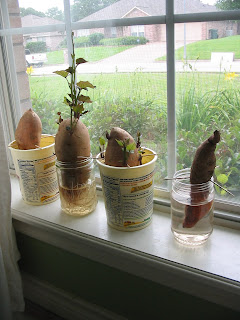
Ok. Now, you take the potatoes and put them in a jar or cup. If it won't wedge into the cup and hold itself up about halfway, you'll need to stick the potatoes with toothpicks to keep it standing up. Put the jars in a windowsill where they'll get plenty of light. It'll take a few weeks, but eventually, you'll see eyes develop, and then those eyes will grow and grow and grow! When the eyes are about 4-6 inches long, just twist them off at the base and you have 1 slip. You'll get multiple slips per potato. I used three potatoes and got 14 slips out of them before washing them and eating the potatoes for dinner :)

Note: Keep an eye on the jars. You may need to add water from time to time to keep the bottom of the potato submerged.

Step 2: Rooting the slips

Once you have your slips (and keep in mind you don't have to do all the slips at the same time), place them either in another jar of water or in very wet play sand. I tried both methods and they worked equally well, but I enjoyed the jar method better because I could actually watch the roots grow. Keep the sand wet, or if you're just using water, make sure the level of water in the jar stays adequate to cover the growing roots. The jars of water can stay on the window sill. I put the slips rooted in sand out in the yard in the sun. You'll need about 2 weeks of root growth before your ready to plant.

Step 3: Planting the slips

Planting is the easiest step of all. To prep the beds, I used the same soil I use for the other veggies, except I added a bag of play sand to each sweet potato bed because sweet potatoes like sandy soil. It turns out, this also makes them easier to harvest because the soil doesn't get compacted. Sounds good to me!

I planted 6-8 slips per 4x1o foot bed (and a full 1 foot deep). Each slip produces lots of potatoes, as you will soon see. Plant them as deep as you can leaving only a little of the slip sticking out the top of the dirt.

Step 4: Caring for the plants

Over the course of the next four months, the slips will turn into vining behemoths. I had to clip them every few weeks to keep them from taking over the yard. Turns out, you can eat them, if you like...

I kept the beds pretty well watered, watering them the same as I did the rest of the garden. It was so hot here in Texas that the leaves were very limp in the hottest part of the day - definitely an indication they needed water. Otherwise, the leaves and very perky. In the last few weeks of growth, I watered far less (once every few days) as you want the soil to be dry when you harvest them.

Step 5: Harvesting the potatoes

My sweet potatoes got so big, they started coming up out of the dirt, so I had no trouble identifying where the original plant was placed. The key here is to be careful and try to not damage on nick the potatoes as you extract them. Gently, dig around the potatoes with your hands, removing excess dirt. Some of the potatoes were small, others were huge, measuring the full 1 foot depth of the bed. Bring it on!

Now, this is something I didn't know. There are potatoes, but there are also lots of more undeveloped sweet potato-y roots chunks. These smaller pieces, I went ahead and washed and put in the fridge for stir fries. The ones that actually look like potatoes? Just set them aside. Do not wash them or let them get wet!

Step 6: Curing the potatoes

This step doesn't seem to be an exact science. I mean, you can eat the potatoes immediately, for sure, but if you let them sit out in the hot, humid air, they actually get sweeter and will be preserved for winter. Now, I had A LOT of potatoes per plant and preserving them was really the only way to go.

For at least 10 days, set the potatoes in a place where it's warm and humid. My back porch did the trick. I first laid newspaper down, placed the potatoes on top of the paper, covered them with my compost sifter (so no critter could carry them off) and then covered the sifter with a tarp - just in case it rained one night and I didn't want to rescue potatoes at 3:00 in the morning. Call me lazy. But hey, it also helped to keep the air around the potatoes warm and moist.

Step 7: Storing the potatoes

After you've allowed them to sit on the porch for
a good 10 days to two weeks, gently brush the dirt off with your hands (remember, you don't want to wash them until you use them), and place them in a box (I used a rubbermaid tub) with newspaper both underneath and on top. I placed mine in our coat closet which is pretty much the coolest darkest place in the house. I understand they keep best in 60 degree temps, but our internal house temp is as close as I can get since I don't have a root cellar and you definitely don't want to put them in the fridge. Now, they SHOULD keep all winter.

Cool, huh? That's all I did. Now we'll see how well they keep in that closet, but then, I may eat them all long before winter is over. The fact of the matter, though, is if I can do it, anyone can do it. And not only was it easy, it's darn good eating!

Monday, October 12, 2009

Local diet update - October 12, 2009

Well, it was a little nippy Saturday morning, but with almost 20 vendors and a parking lot full of fresh, local food and crafts, the farmers' market was the place to be. Seriously. Take a look a this! Available at this week's Brazos Valley Farmers' market were
Veggies and Fruits: red potatoes, yellow onions, hubbard squash, patty pan squash, collards, carrots, cherry tomatoes, sweet potatoes, cucumber, yellow squash, zucchini, green beans, a variety of hot and sweet peppers, okra, spinach, herbs, black eyed peas, dried apples, and pears

Baked Goods: yeast breads, herb breads, sweet breads, peanut brittle, cookies, pound cake, carrot cake, croutons, cheesecake bars, pecan bars, dog treats

Canned Goods: jams, jellies, salsas, pickles, chow-chow, relish, veggies, chutney, veggies

Other Foods: cornmeal, grits, wheat flour, eggs, honey, hot pepper sauce, jalapeno oil, locally-roasted peanuts, locally-roasted coffee, olive oil

Non-Food Items (hand-crafted): soaps, lotions, perfumes, stained glass art, decorative plants, fruit trees, vegetable and herb seedlings, aprons, greeting cards, plaques, jewelry, pot holders, dog bowl stands, pottery, bags, purses, a variety of welded iron work (lawn ornaments, plant stands, knick-knacks, etc)
Seriously! Can you beat that harvest? Not to mention all the awesome crafts to get you thinking of the holiday season (there's still plenty of time to join the "Buy Hand for the Holiday" challenge).

Of course, despite having finished off all the leftovers in the fridge this past week, I still have tons of local food still at home between the backyard garden (harvesting sweet potatoes, green onions, green pepper, and sage), the local watermelon and eggs in the fridge, and the local soups, corn, pasta sauce, whole wheat flour and jams/jellies in the pantry. Yeah, I didn't need much so I kept it simple, just picking up some red potatoes and carrots for Dave's steamed veggie medley and a zucchini given to me by one of the market vendors (Thanks, Helen!). Mmmm! Local tastes good!

And I'm still going strong with Chile's 100 Day Challenge, where I'm challenging myself to eat only what I have preserved, grown myself, or bartered for (aka no spending money on food for myself except for fruit). It actually feels good to start whittling away at some of the pantry supplies. It was getting out of hand and this challenge is a good excuse not to buy anything for awhile - let's face it, I have no self control at the farmers' market without the accountability of the challenge...

So what's local in your neck of the woods?

Have a great week, everyone. And as always, Happy (and mindful) eating!

Friday, October 9, 2009

Diet for a Small Planet - A book review

I first became aware of Diet for a Small Planet by Frances Moore Lappé when it was referenced in Samuel Fromartz's Organic Inc.: Natural Foods and How they Grow. It turns out, Diet for a Small Planet is an almost 40 year-old look at the connection between world hunger and how we eat; and, more importantly, what we can do about it. It has also, I found out, been updated in a 20th Anniversary Edition, which is the one I picked up at our local library.

Lappé begins by walking us through her personal journey into third world countries as she sought to get to the bottom of world hunger. She finds that it is not, as many think, a shortage of food, but rather the imbalance of power between people and a wealthy few (whether government or corporation). A trend, she notes, that she sees more and more in the United States as only a few corporations monopolize the entire food system.
[W]e can see where this blind production imperative has taken us - away from values that Americans have always associated with democracy, and toward a "landed aristocracy"; away from dispersed control over land, and toward a highly concentrated pattern of control; away from a system rewarding hard work and good management, and toward one rewarding size and wealth alone. As I suggested earlier, ours is becoming the kind of farm economy that I have see at the root of so much injustice and misery in the third world."
The book can then be divided into three themes, the problems with food currently gracing our supermarket shelves, what we can do about it, and a near 150 pages of recipes to inspire change in your own diet.

Problems with our food infrastructure and diet

First thing's first. We can't change our food habits if we don't know what's wrong. Interestingly enough, much of what Lappé discusses are food infrastructure pitfalls in 1971 is still true today. First, she delves extensively into how the cheap cost of meat and processed foods mask the true cost of goods (ground water depletion, soil erosion, government subsidies, etc) and how grains are fed to animals instead of a hungry population (so that it can be sold for more money to wealthier populations). And second, that there have been dangerous changes to the US Diet that make it unhealthy for our bodies, the environment, and the world. Check this out...
  1. Protein from animals instead of plants
  2. More fat
  3. Too much sugar
  4. Too much salt
  5. Too little fiber
  6. Too much alcohol
  7. More additives, antibiotic residues, and pesticides
  8. Too many calories
Wait, just sec. Yep, originally written in 1971. Any of this sounding familiar?

What we can do about it

But as is so often the case, the question really comes down to, what can I do about it? And here's what I loved most about this book: Lappé believes in the power of the individual to change the world.
[H]ow can we take responsibility for the future unless we can make choices now that take us, personally, off the destructive path that has been set for us by our forebears.
We don't have to be anyone special, she tell us. We just need to use the talents we have to make changes in our lives and in our communities. Change is happening, she says, "we don't have to start the train moving. It is moving! Our struggle is to figure out how to board that train, bringing on board all the creative energy we can muster."

If you are reading this blog, chances are you are already on this train. The trick, though, is that to continue our journey, we must be ever vigilant, learning each and every step of the way. She reinforces this as she advocates not a vegetarian diet (which is what I would have expected), but rather one of mindful awareness.
[F]reedom is not the capacity to do whatever we please; freedom is the capacity to make intelligent choices. And that is what this book is all about - gaining the knowledge we need to make choices based upon awareness of the consequences of those choices.
May you read and be inspired.

Recommended: to those interested in world food infrastructures as well as how our diets affect our bodies and the world around us
Rating: 3 of 5 stars
This and tons of other great eco-book reviews can be found at the Blogging Bookworm. Be a bookworm today and check it out!

Thursday, October 8, 2009

Organic Inc - A book review

Having spent the summer reading books that have fueled my private meditation sessions, I decided a nice eco-read was in order for the next review. And, really, how can you go wrong with a title like Organic Inc.?

Samuel Fromartz's Organic Inc: Natural Foods and How They Grew (Harcourt Books, 2006) is a look into the history, and in fact evolution, of organics in the United States. Why? Fromartz, a dedicated Whole Foods shopper and buyer of organics was fascinated by the movement and curious as to its roots. A business writer by trade, Fromartz travelled the country meeting with industry leaders, historians, and farmers to discover the true roots of the organic movement.

What he discovered is that although organics began with growers, dedicated to the nourishment of body and Earth, the movement quickly became a big-business sensation where large companies like Archer Daniels Midland, Coco-Cola, ConAgra, General Mills, Kraft and others own the bulk of the organic market.
For the path that agrarian idealists had taken in the 1970s - to farm in concert with nature and sell organic food outside the dominant food system - became compromised by its success. Organic food had become too popular to remain in a backwoods niche, morphing into yet another food industry profit center.
The result has pitted industry vs. small farmer in the creation of government regulation. Purists want organics to be focused on fresh, whole foods, but industry needs processed food to maximize profits. The battle continues today with standards continuously under attack. Can heavily processed foods truly be called organic or does that defy the intention of the organic movement?

In the meantime, organic regulations change seemingly to whim - at times allowing any number of synthetic ingredients, wavering over the definition of "access to pasture" (for the meat and dairy industries), and are compromised when companies are repeatedly caught fraudulently packing conventional produce in organic packaging. What's a consumer to believe? How are we to make educated choices?

As for the book itself, it was an interesting read, though I almost gave up in Chapter 4, a 40 page section dedicated to Spring Mix. Maybe it was me, but I had a hard time staying focused. The faithful reader's perseverance will pay off however, as Fromartz lays out the politics of organics in the last half of the book, leaving it up to us, the reader, to decide: What should organic mean?

Recommended: to those interested in the history and politics of the organics movement
Rating: 3 of 5 stars
This and tons of other great eco-book reviews can be found at the Blogging Bookworm. Be a bookworm today and check it out!

Market to Table - October 8, 2009

Believe it or not, I've been eating nothing but leftovers from last week. Talk about eating well without spending an extra dime! The remnants of last week's Veg*n pot luck were quickly devoured (not local, but vegan and free - I love free...); I've finally worked my way through the last of the veggie and rice casserole I made last week with the help of my homemade, all-local italian soup; and Dave's steamed local veggies, also leftover from last week, found it's way to my tummy in the company of some local brown rice, literally the only thing I cooked this week.

In lieu of recipes of things you've found a hundred times on SGF (I know, I eat a ton of stir fries and casseroles, after all, I'm a lazy cook), I thought I might share with you the recipe for italian soup that I used the last time I used the pressure canner. I think this is my favorite of all the soups I've made over the last two years. It's great by itself, or added to a rice dish for a nice stovetop casserole.

So without any further ado, Italian soup...

SGF's Italian Soup
  • 4 large carrots, chopped
  • 1 large cucuzza squash, peeled and chopped
  • 12 large okra
  • 8 large mushrooms, chopped
  • olive oil
  • 1 pint corn
  • 1 pint pasta sauce
  • veggie broth (as much as you can get - I reserve the broth from steaming veggies)
  • water
  • Anna's herbs (a mixture of italian herbs I found at our local organic grocery)
  • salt
First, I chopped all the fresh veggies and sautéd them in olive oil in a large soup pot. This is what I had on hand from the farmers' market and from a neighbor's garden. Use whatever you have on hand that sounds good.

When the veggies softened, I added a pint of corn I canned from the farmers' market and a pint of my homemade, all-local pasta sauce. I also added as much veggie broth as I had on hand, then topped the pot off with water.

I allowed the soup to simmer 1-1/2 to 2 hours on the stove on low heat, adding herbs and salt to taste.

That's all there is to it! It's so easy, you can use whatever you have on hand, and even more or less veggies - whatever suits your taste. The diluted pasta sauce gives it a nice tomato-y flavor without tasting like your slurping spaghetti. :)
As I mentioned above, I love this soup by itself or made into a stove-top casserole dish. Here's a photo of the casserole I made last week with 1 quart of this soup.

Basically, I poured the soup in a saucepan with 1 cup of rice, brought the mixture to boiling, and then let it simmer on the stove for about 45 minutes. While the rice is cooking in the soup, I sauteed chopped eggplant, zucchini, onion, and peppers (all local) in a little olive oil. When the veggies were softened, I just set them aside until the rice was done. When the rice was ready, I emptied the sauteed veggies in the sauce pan with the "souped-up" rice, and voila - Super-duper, Easy-cheesy, Stove-top Veggies and Rice. And it's all local! Doesn't get any better than that!

Pshew! The fridge has now been cleared of leftovers and I'm ready for a fresh run on the pantry goods and veggies from the backyard for next week. And of course, you never know what I'll come home with from the farmers' market this Saturday. Stay tuned to find out!

In the meantime, Happy (and mindful) Eating!